
Most of my musings will be based on research I carried out for a PhD. Anyone wishing to read in-depth analysis will find it in my thesis entitled ‘Electrifying the streets: the surface-contact controversy in five English towns 1880-1920’. This first blog will be about the meaning of streets to the Victorians, how streets were used, and and how society had to adapt to technological change. Further blogs will consider the aesthetic and environmental impact on the urban fabric, which varied considerably between towns. Eventually I hope to write about how new modes of travel affected women and children, and how transport systems were appropriated into social interaction and game play. In future blogs I hope to include my research into historic urban transport systems in other countries,and in particular Kenya where I lived for many years. So here goes!
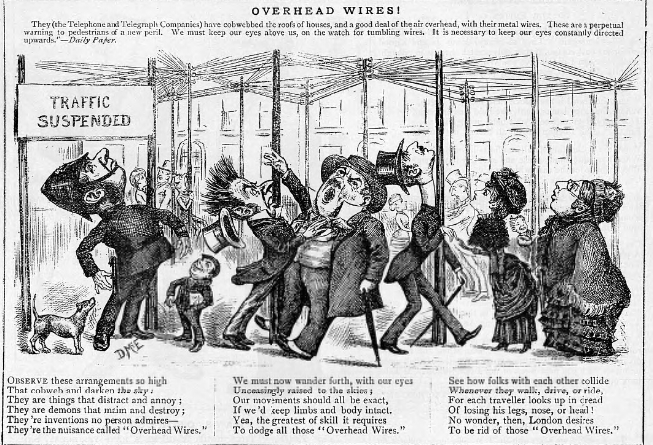
Cartoon from the satirical Fun Magazine, London, 28 November 1883
Apart from providing access to dwellings, streets were used for social purposes in the densely populated areas of nineteenth century towns. Scenes of everyday life were chaotic, alive and sometimes exciting. In lower-class areas, people gathered to socialise and trade goods, and for children streets were informal playgrounds where they enjoyed popular games. Movement on foot encouraged social interaction and cohesion. Attempts to introduce formal transport routes were therefore resisted as residents feared the social amenity would be lost.
But in wealthier parts of towns, streets had different functions. There people promenaded and paraded in their carriages. All, however, were united in their resistance to streets becoming thoroughfares for transport, but as the century progressed it became impossible to stem the tide of change.
First of all came horse-drawn omnibuses, based on a modification of existing intercity stagecoaches. By the mid 1830s, they had appeared in many UK towns and cities. However, these omnibuses had severe limitations due to the rough nature of the roads which restricted travel speeds to five or six miles per hour. They were also uncomfortable and posed safety hazards to both passengers and pedestrians due to the difficulty in controlling horses in an urban situation. High fares also excluded the general population from using them.
It was not long before rails were introduced to the urban scene, and the first horse-drawn trams appeared. The major advantage was the reduction in friction between wheels and track which enabled greater efficiency and a more comfortable ride. Originally, the rails protruded above the road surface which caused damage to the wheels of carriages and omnibuses. Inevitably, accidents and some fatalities occurred when vehicles overturned on attempting to mount the rails.
Other problems soon appeared. Horses were neither swift nor powerful when pulling vehicles of around 2 tonnes, and the stop/start operating nature reduced the working life of a horse to around four years, after which they were often unfit for any other work. Horses were also expensive to maintain and when they were not working, they were ‘eating their heads off’. They were also prone to illness in an urban environment. An epidemic could result in the deaths of hundreds of horses. In addition, they were unhygienic as each horse deposited thirty pounds of manure and two gallons of urine every day on the roadways, creating significant public health hazards. This problem was exacerbated by the tramway operators’ practice of storing manure in enormous heaps near their stables in order to sell it to farmers for fertiliser.
Consequently, objections to horse-drawn vehicles gathered momentum. Appalled by scenes of brutality to overworked horses, social reformers raised concerns about animal welfare. Road surfaces were not particularly well maintained, and horses were frequently injured through straining and slipping when leaving a stop. The constant exertion resulted in deaths on the streets, a scene that caused much anguish to residents and passers-by.
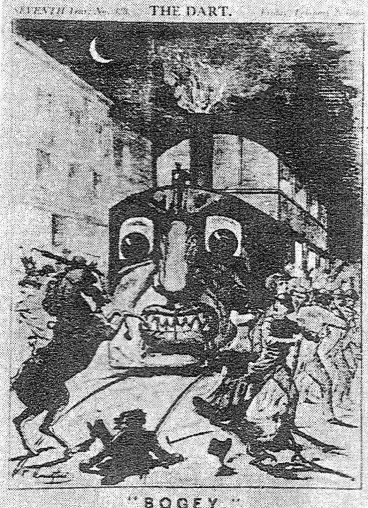
As a result, in many towns mechanisation was explored. Steam transport had been proven effective in an inter-urban context, but needed to be scaled down and adapted to suit urban street requirements. Several variations of steam powered trams appeared. The primary benefit was economic as a steam tram could do the work of five horses at less than half the cost. However, they were not universally welcomed due to the danger to the public from scared runaway horses, noise levels, and pollution from excessive smoke and steam emissions in built-up areas. To overcome the problem of unsightliness to the public and distress to horses, trams were enclosed with a box-like body to minimise their appearance. In many towns the number of accidents persuaded the public that animal power was perhaps better suited to the crowded streets.
By the mid 1880s, experimentation had begun with electricity as a source of tractive power. However, the general public had little experience of something so revolutionary, and were frightened by such an unseen yet powerful force. Most towns adopted the overhead power supply system but many considered this dangerous because high winds could bring down the wires, leaving pedestrians at risk of electrocution. The more fanciful even worried that inquisitive people might touch overhead wires with umbrellas or similar objects with disastrous results.
A few towns in the UK and continental Europe objected to overhead wires on aesthetic grounds. Already, telegraph wires had created an extreme dislike (see the illustration above) and this distrust developed into a strong and powerful movement by pedestrians and some politicians against visual pollution. Support poles were not particularly attractive, and some residents went so far as to threaten to chop them down, Eventually, ornate cast iron supports were developed in an attempt to enhance the urban scene.
As more streets became urban transport routes, social activities and even children’s street games changed. New games included jumping on and off moving trams – a very dangerous activity resulting in many accidents – placing coins on the line to compare deformity, and racing trams between stops. On board, women had a certain amount of freedom. As passengers they were on equal terms with men and trams became places where men and women could meet outside their traditional spheres.
Thus the advent of new transport systems had a massive impact on urban society and the function of streets. In my next blog, I will write about my home city, Wolverhampton which adopted a unique system of traction for its trams, consisting of an underground electrical supply. This was aesthetically and environmentally more pleasing to the city fathers and general population, although it was more expensive to build and operate. Nevertheless, it lasted for almost twenty years at the turn of the twentieth century.
 A Brief History Of Many Things